
Mold Design Fundamentals
Published Jun 23, 2026 | Posted in Manufacturing, Technology
Mold Design Fundamentals Start Before Steel Is Cut
The best time to solve a molding problem is before steel is cut.
In injection molding, production issues are rarely random. A tool may run well during launch, only to slowly drift out of control over time. Some problems appear immediately. Others take weeks or months to show up. Some molds run for millions of cycles with consistency, while others fight production every day.
When this happens, the answer is not always the machine, the material, or the process.
Often, the answers are in the mold itself.
More specifically, the answers can usually be traced back to three core mold design fundamentals:
Flow. Thermal. Mechanical.
These three pillars influence how plastic moves through the mold, how heat is managed, and whether the tool can repeat the cycle reliably over time. For large, complex, cosmetic tooling, especially in commercial goods applications, these fundamentals directly affect appearance, cycle time, dimensional stability, part quality, tool life, and long-term production performance.
Cavalier Tool was proud to participate in Mold Making Technology’s Mold Design Fundamentals webinar, where our International Business Development Manager, Chris Vander Park, and Engineering Manager, Shawn Spence, joined the conversation on the three pillars of mold design:
At Cavalier Tool, we incorporate these mold design fundamentals as part of the engineering process long before manufacturing begins.
Pillar One: Flow
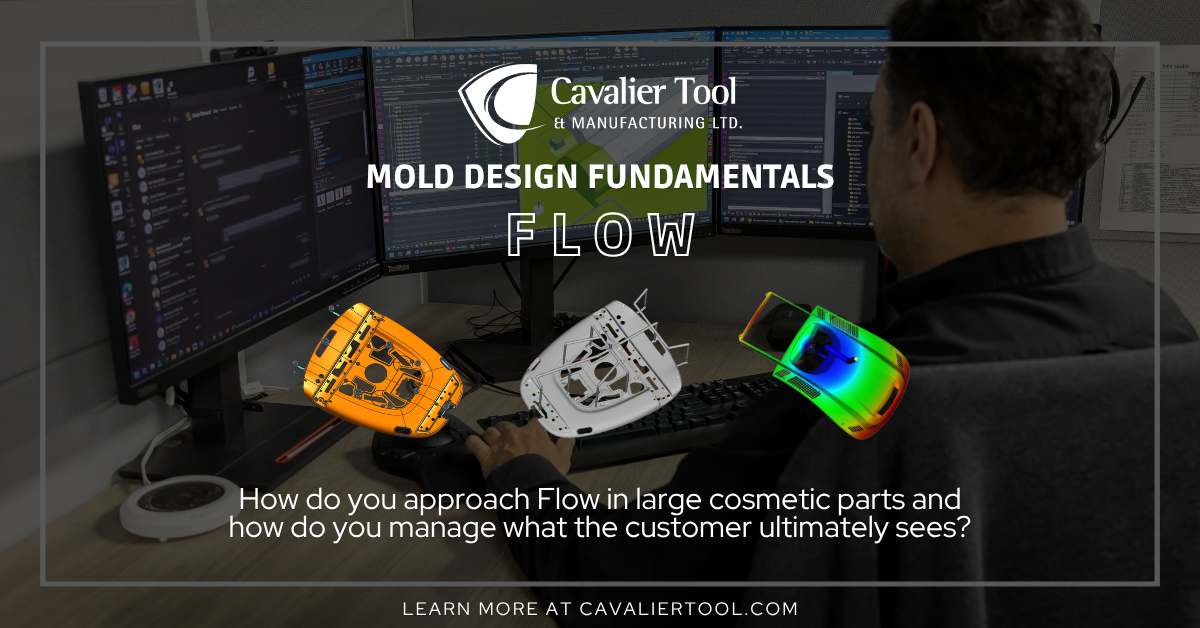
Flow is not just about filling the part.
It is the starting point of every mold design.
Before cooling is finalized, before ejection is planned, and before steel is cut, there is one fundamental question:
How does the plastic get into the mold?
Flow defines the fill pattern. It determines pressure demand. It influences weld lines, air traps, hesitation, and cosmetic outcomes. In large, complex, cosmetic tooling, Flow is often what the customer sees.
A weld line in the wrong location, a flow mark across a visible surface, a hesitation point that affects appearance, or a gas trap that creates downstream quality issues are not just processing concerns. They are design concerns.
That is why gating strategy and Moldflow analysis are critical upfront activities.
At Cavalier Tool, Flow is evaluated before the design moves forward. Fill time, cavity pressure, injection velocity, runner balance, gate wear, venting, and press tonnage limitations all need to be considered.
For large-tonnage tools, pressure control is a major focus. By reviewing different design iterations, gate locations, valve gate timing, and fill-front strategies, the goal is to control how the plastic moves through the tool before it ever reaches production.
Flow does more than fill the cavity.
Flow defines the process window.
Pillar Two: Thermal
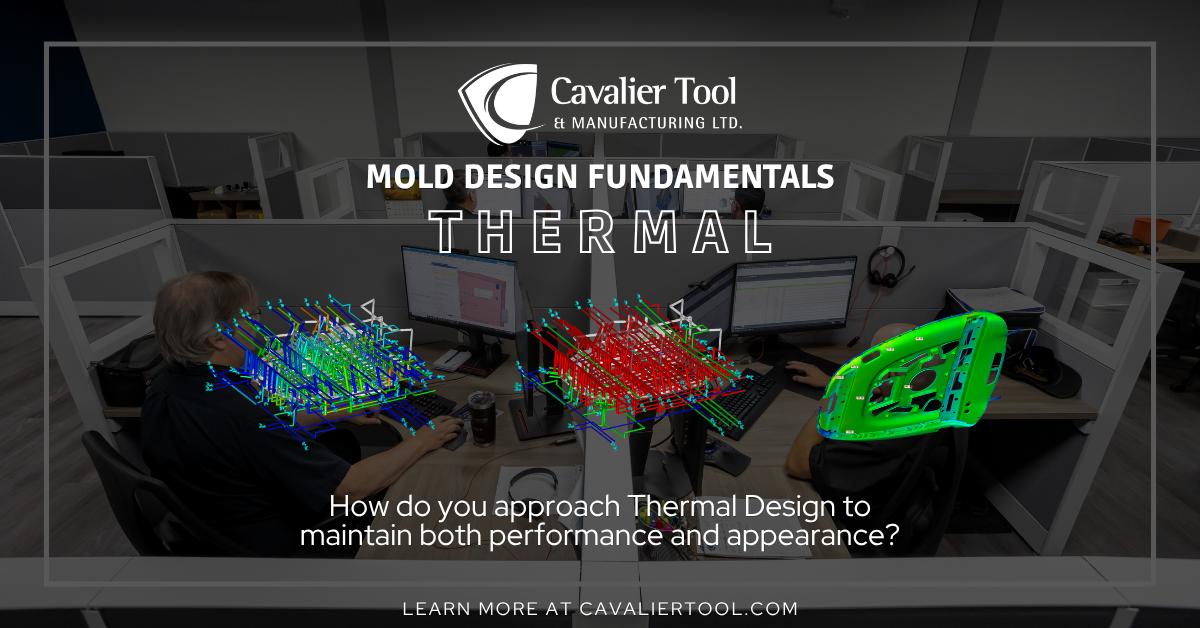
Thermal is where molds begin to fail quietly.
Thermal problems do not always stop production immediately. Instead, they drift.
Cycle time starts to increase. Dimensions begin to move. Warpage develops. Gloss variation appears. Consistency starts to fade.
The mold may still be running, but it may no longer be stable.
That is why Thermal is one of the most important mold design fundamentals. Thermal tells us how heat is introduced, transferred, and removed from the mold. It helps determine whether the process will stabilize or slowly drift out of control.
In large, complex, cosmetic tooling, Thermal shows up in the part’s appearance and fit. Sink, warpage, dimensional movement, and surface variation are often thermal problems, not just processing problems.
At Cavalier Tool, Thermal design is evaluated through cooling circuit layout, mold temperature review, thermal simulation, flow rate, Reynolds Number, water line length, distance from surface, baffles, supply and return strategy, and the customer’s available water capacity.
The goal is not just to cool the part quickly.
The goal is to cool the part consistently, strategically, and in a way that protects both performance and appearance.
A mold can be running and still be drifting thermally. When that happens, part quality follows.
Pillar Three: Mechanical
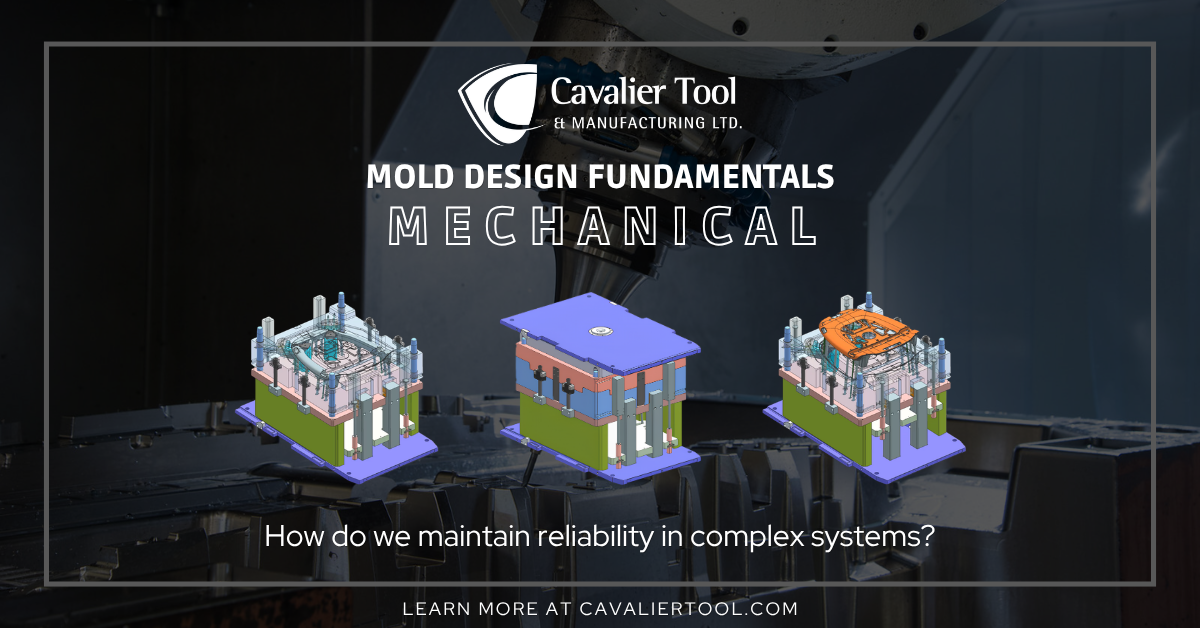
Mechanical is about motion, wear, and survival.
No mold operates in ideal conditions. It operates under force, heat, friction, pressure, material behavior, and time. Over time, everything wears.
Mechanical design tells us whether the mold can still repeat the cycle after launch, after production begins, and after thousands or millions of cycles.
Without mechanical stability, Flow and Thermal do not matter.
A tool may fill properly. It may cool effectively. But if it cannot open, close, align, eject, shut off, and repeat reliably, the process will not hold.
In large, complex commercial goods tooling, mechanical complexity often increases. Slides, lifters, shutoffs, large components, automation interaction, and complex ejection all have to work together.
At Cavalier Tool, Mechanical design is reviewed through Design for Manufacturability, draft analysis, block studies, rib studies, tooling action studies, shutoff angle review, ejection clearance, and full design simulation.
The goal is to prove the mold will function as intended before it is built.
A tool does not just need to work at launch.
It needs to survive production.
Flow, Thermal, and Mechanical Are Never Designed Independently
The three mold design fundamentals are not separate systems.
They are connected.
A decision made to improve Flow can affect Thermal. A cooling decision can limit ejection. A mechanical action can force water lines, hydraulics, support steel, or shutoffs to move.
Every change creates another consideration.
In large, complex, cosmetic tooling, this matters because the customer does not see the design compromise. The customer sees the final part.
They see the surface finish. The fit. The consistency. The dimensional stability. The cycle time. The long-term performance.
Flow tells us how the plastic moves through the mold.
Thermal tells us whether the process will stabilize or drift.
Mechanical tells us whether the mold can repeat the cycle over time.
But the real challenge is understanding how all three interact inside one tool.
That is why early engineering review, Moldflow analysis, cooling strategy, DFM, action studies, and simulation are so important before steel is cut. A mold is not a collection of separate systems. It is one connected system.
The best tooling outcomes come from understanding how every design decision affects the whole mold.
Design Compromises: Where Mold Design Becomes Engineering
There is no perfect mold.
There is only the right compromise.
Every design decision improves something and makes something else more difficult.
Add an ejector pin, and a water line may need to move. Improve cooling in one area, and you may affect ejection. Add support steel, and you may increase cost, weight, or complexity. Adjust a shutoff, and you may change how the tool wears over time.
In large, complex, cosmetic tooling, these compromises matter because the final part still has to meet the customer’s expectations for appearance, fit, function, cycle time, and long-term production performance.
Some of the most common design compromises include:
Water vs. Ejection
Cooling needs space. Ejection needs space. Depending on part geometry and structural requirements, the ejection needed to properly release the part can limit the available space for water.
Steel Support vs. Cost
Adequate steel support is critical, but unnecessary steel adds cost, weight, and complexity. In some cases, additional steel may also be required to properly support water placement within the mold.
Steel for Locking Against Injection Pressure
Mold steel must be supported correctly to withstand injection pressure, especially on larger tools. Locking, backing steel, and support strategy all play a role in long-term mold performance.
Required Ejection Stroke
Stroke requirements depend on how the part is being handled. The mold may need to present the part to a robot, support automation, allow the part to free-fall, account for material shrink, use air assist, or work within press constraints.
Mold Base Material Selection
Material selection depends on the plastic being molded, wear characteristics, expected production volume, and overall mold life requirements.
The goal is not to avoid compromise.
The goal is to make the right compromise without sacrificing the customer’s end result or the longevity of the mold.
Why Mold Design Fundamentals Matter for Long-Term Production
Great tooling is not just about building a mold that works at launch.
It is about engineering a mold that performs over time.
That requires understanding how Flow, Thermal, and Mechanical decisions affect the entire tool. It also requires experience, simulation, manufacturability review, and practical tooling knowledge before steel is cut.
For commercial goods, consumer goods, recreational vehicles, agriculture, and other large-part applications, mold design fundamentals play a direct role in production success.
They influence:
- Part appearance
- Dimensional stability
- Cycle time
- Cooling performance
- Ejection reliability
- Tool wear
- Process consistency
- Long-term mold life
When these fundamentals are addressed early, customers are better positioned for stable launches, stronger production performance, and fewer downstream issues.
Partner With Cavalier Tool Before Steel Is Cut
Cavalier Tool & Manufacturing Ltd. designs and manufactures large, complex plastic injection molds for customers around the world. Our engineering team applies mold design fundamentals through Moldflow analysis, thermal review, Design for Manufacturability, mechanical simulation, and full lifecycle tooling support.
For challenging programs, the best results come when tooling strategy is evaluated early.
If your team is developing a large, complex plastic component, Cavalier Tool can help review the Flow, Thermal, Mechanical, and design compromise considerations before they become production problems.
Contact Cavalier Tool to discuss your next tooling program.
Article Written by Luke Geschiere